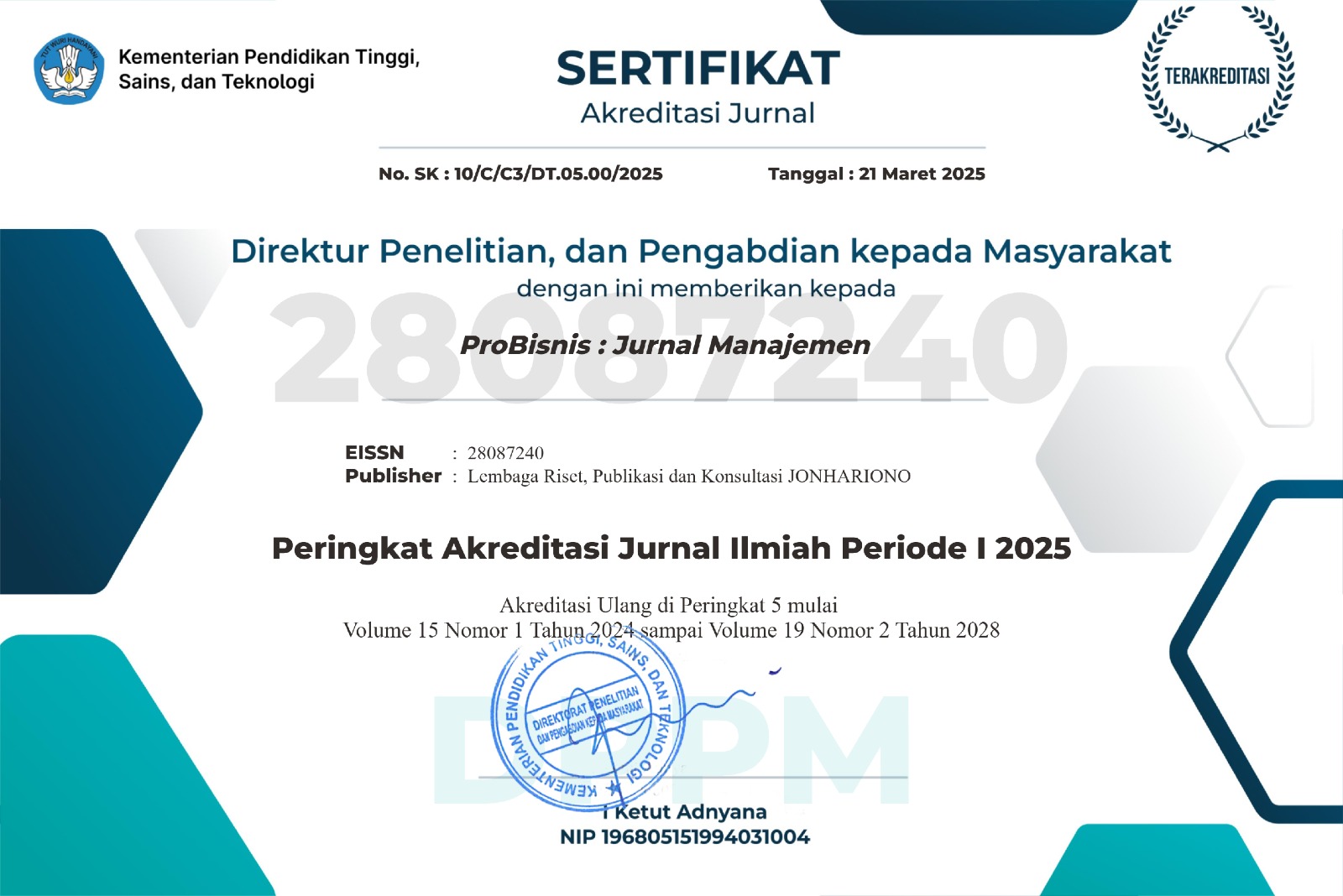
Perilaku Pembelian Produk Langka Thrifting: Peran Mediasi Perceived Behavioral Control
Keywords:
Thrifting, Rarity product, Perceived behavioral control, Impulsive buying, Compulsive buyingAbstract
This study examined rare-product purchasing behavior in the fashion-thrifting market in Bali by testing the roles of relative advantage, compatibility, and complexity in perceived behavioral control, as well as the consequences for impulsive and compulsive buying. A quantitative explanatory design was applied to 300 Bali residents who had purchased thrifted clothing more than three times. Data were collected through a four-point Likert-scale questionnaire and analyzed using Partial Least Squares Structural Equation Modeling. The measurement model met convergent validity and reliability requirements. The structural results showed that relative advantage, compatibility, and complexity positively and significantly affected perceived behavioral control. Perceived behavioral control positively affected impulsive buying, while impulsive buying positively affected compulsive buying. Perceived behavioral control also significantly mediated the effects of relative advantage, compatibility, and complexity on impulsive buying. These findings indicate that consumers’ confidence in navigating prices, product uniqueness, suitability, authenticity, quality, size, and limited availability can intensify spontaneous purchase decisions. Repeated impulsive purchases may subsequently develop into compulsive tendencies. Thrift-business operators should therefore provide clear product information and an easy purchasing process while applying ethical marketing practices that do not exploit consumers’ loss of self-control
References
Ajzen, I. (1991). The theory of planned behavior. Organizational Behavior and Human Decision Processes, 50(2), 179-211.
Beatty, S. E., & Ferrell, M. E. (1998). Impulse buying: Modeling its precursors. Journal of Retailing, 74(2), 169-191.
Csikszentmihalyi, M. (1990). Flow: The psychology of optimal experience. Harper & Row.
Csikszentmihalyi, M. (1997). Finding flow: The psychology of engagement with everyday life. Basic Books.
Faber, R. J., & O’Guinn, T. C. (1992). A clinical screener for compulsive buying. Journal of Consumer Research, 19(3), 459-469.
Ghozali, I. (2015). Partial least squares: Konsep, teknik dan aplikasi menggunakan program SmartPLS 3.0. Badan Penerbit Universitas Diponegoro.
Ghozali, I., & Latan, H. (2015). Partial least squares: Konsep, teknik dan aplikasi menggunakan program SmartPLS 3.0 (2nd ed.). Badan Penerbit Universitas Diponegoro.
Hair, J. F., Hult, G. T. M., Ringle, C. M., & Sarstedt, M. (2022). A primer on partial least squares structural equation modeling (PLS-SEM) (3rd ed.). Sage.
Hoffman, D. L., & Novak, T. P. (2009). Flow online: Lessons learned and future prospects. Journal of Interactive Marketing, 23(1), 23-34.
O’Guinn, T. C., & Faber, R. J. (1989). Compulsive buying: A phenomenological exploration. Journal of Consumer Research, 16(2), 147-157.
Rogers, E. M. (2003). Diffusion of innovations (5th ed.). Free Press.
Rook, D. W. (1987). The buying impulse. Journal of Consumer Research, 14(2), 189-199.
Rook, D. W., & Fisher, R. J. (1995). Normative influences on impulsive buying behavior. Journal of Consumer Research, 22(3), 305-313.
Sugiyono. (2018). Metode penelitian kuantitatif. Alfabeta.
Sugiyono. (2019). Metode penelitian kuantitatif, kualitatif, dan R&D. Alfabeta.
Verplanken, B., & Herabadi, A. (2001). Individual differences in impulse buying tendency: Feeling and no thinking. European Journal of Personality, 15(S1), S71-S83.